Broadcom’s CEO on $4bn AI sales, tariffs, VMware and ‘stepping up’ cloud R&D
Here are the biggest remarks from CEO Hock Tan around total AI sales, VMware customers, enabling AI for hyperscale cloud providers and potential impact of tariffs
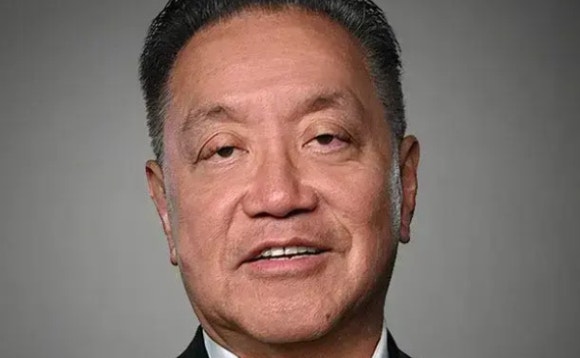
Broadcom reported a record $14.9bn (£11.52bn) in sales during its first quarter 2025 as CEO Hock Tan highlighted his company’s booming AI sales, hyperscale cloud customers, the potential impact of tariffs and new VMware customer statistics.
“We beat our guidance for AI revenue of $3.8bn due to stronger shipments of networking solutions to hyperscalers on AI,” said CEO Hock Tan during Broadcom’s Q1 2025 financial earnings call.
“Our hyperscaler partners continue to invest aggressively in their next-generation frontier models, which do require high-performance accelerators, as well as AI data centers with larger clusters,” he said.
“And consistent with this, we are stepping up our R&D investment on two fronts.”
The California-based tech giant now has an annual run rate of nearly $60bn.
In terms of VMware and VMware cloud foundation (VCF), Broadcom is focused on “upselling customers to a full-stack VCF,” which enables the entire datacentre to be virtualised to enable customers to create their own private cloud environment on-prem.
“As of the end of Q1, approximately 70 per cent of our largest 10,000 customers have adopted VCF,” he said.
CRN breaks down the five biggest highlights and boldest remarks from Hock Tan on the chipmaker and software company’s Q1 2025 results and future.
Broadcom’s Q1 earnings results
Before jumping into Tan’s biggest statements, let’s take a quick look at the Broadcom’s financial results for first quarter 2025, which ended 2 February, as the tech giant continues to drive AI on a global basis.
Broadcom generated $14.9bn during the first quarter, which bested Wall Street’s expectations of $14.62 in total sales.
The $14.9 bn in revenue represents a 25 per cent year-on-year increase compared to approximately $12bn during Q1 2024.
Broadcom’s net income increased a whopping 315 per cent to $5.5bn in Q1 2025 compared to $1.3bn year-on-year.
Here is what Hock Tan said regarding its AI revenue, VMware momentum, potential tariff impact on business and enabling hyperscale cloud providers with Broadcom’s innovation.

Broadcom AI sales hit $4.1 bn
Broadcom said it generated $4.1bn in AI sales during the quarter, representing a 77 per cent increase year-on-year.
AI sales were driven by strong shipments of networking solutions to hyperscalers leveraging Broadcom’s Tomahawk switches and high-performance accelerator chips.
“We’re pushing the envelope of technology in creating the next generation of accelerators,” Tan said.
“We’re [building] the industry’s first two-nanometer AI XPU packaging 3.5D as we drive toward a 10,000 teraflops XPU.
“Secondly, we have a view toward scaling clusters of 500,000 accelerators for hyperscale customers. We have doubled the RAID X capacity of the existing Tomahawk sites.”
Broadcom’s AI sales are included as part of its semiconductor solutions business, which grew 11 per cent year over year to $8.21bn in Q1 2025.
Looking ahead, Broadcom is projecting AI revenue to grow to $4.4bn during its current second quarter 2025, which would represent a 44 per cent increase year-on-year.

Hock Tan on potential tariff impact
Tan was questioned about if global tariffs that the Trump administration is seeking to implement would impact Broadcom in any way.
“It’s really too early to know where we all land.
“I mean, there’s the threat, the noise of tariffs - especially on chips that hasn’t materialised yet, nor do we know how it will be structured,” Tan said.
Tan said his company is trying to look at global tariff disruptions “in a positive way” regarding the semiconductor industry as new AI innovation and data sovereignty rules are evolving at breakneck speed.
“As far as you mentioning tariffs is concerned, I think that’s too early for us to figure out way,” he said.
“Probably give it another three to six months. We will probably have a better idea of where to go.”

Sales and innovation momentum with giant providers
Broadcom is currently developing custom AI chips with three large cloud customers.
The world’s three cloud computing market share leaders are AWS, Microsoft and Google Cloud.
“To enable AI clusters to scale up on Ethernet toward one million XPUs, we have [built] our next-generation 100-terabit Tomahawk 6 switch running 200G studies at 1.6 terabit bandwidth,” said Tan.
“We will be delivering samples to customers within the next few months.”
“These R&D investments are very aligned with the roadmap of our three hyperscale customers as they each race toward one million XPU clusters by the end of 2027,” he said.
“We expect these three hyperscale customers will generate a serviceable addressable market in the range of $60bn to $90bn in fiscal 2027.”
In addition to those three large cloud customers, Tan said his company had “deeply engaged” with two other hyperscalers, and is working with four other potential customers to develop their own custom AI chips.
“In the process of working with the hyperscalers, it has become very clear that while they are excellent in software, Broadcom is the best in hardware.
“Working together is what optimises LLMs,” he said.
VMware momentum; 60 per cent finished with converting VMware licenses to VCF
Broadcom’s infrastructure software division, which includes VMware software, reached a total of $6.7bn in sales during the quarter.
This presents a 47 per cent increase year-on-year compared to $4.6bn in Q1 2024.
This software spike in growth is due to two reasons.
“One, we’re converting from a footprint of largely perpetual license to one of full subscription,” said Tan.
“And as of today, we are over 60 per cent done.
“Two, these perpetual licenses were only largely for compute virtualisation, otherwise called vSphere.”
VMware vSphere is now part of the VMware cloud foundation packaged bundle offering.
Tan said Broadcom is “upselling customers to a full-stack VCF” that enables customers to virtualise their datacentre and “create their own private cloud environment” on-premises.
“As of the end of Q1, approximately 70 per cent of our largest 10,000 customers have adopted VCF.
“As these customers consume VCF, we still see a further opportunity for future growth,” he said.
As large enterprises adopt AI, they need to run their AI workloads on their on-prem datacentres, which will include both GPU servers as well as traditional CPUs.
“Just as VCF virtualises these traditional datacentres using CPUs, VCF will also virtualise GPUs on a common platform and enable enterprises to import AI models to run their own data on-prem,” he said.
“This platform, which virtualised the GPU, is called the VMware Private AI Foundation.
“As of today, in collaboration with Nvidia, we have 39 enterprise customers for the VMware private AI foundation.”

Broadcom isn’t focused on M&A or developing AI chips with startups
Tan said that Broadcom closely chooses partners for developing custom AI chips who can deploy the resulting product in large quantities compared versus smaller quantities like a startup.
“We eliminate ourselves to how many customers or how many potential customers that exist out there, and we tend to be very selective who we pick.” Tan said.
“It’s just the way we run our ASIC business in general for the last 15 years.
“To put it bluntly, we don’t do it for startups,” he said.
Tan was also asked if there’s any potential acquisitions ahead for Broadcom this year.
“No, I’m too busy,” he said.
“We’re too busy doing AI and VMware at this point.”
This article originally appeared on CRN UK sister website CRN.