AI is rewriting leadership: who is getting ahead and why?
At the Women of the Channel Leadership Summit 2026, panellists discussed the evolution of leadership that is being powered by AI
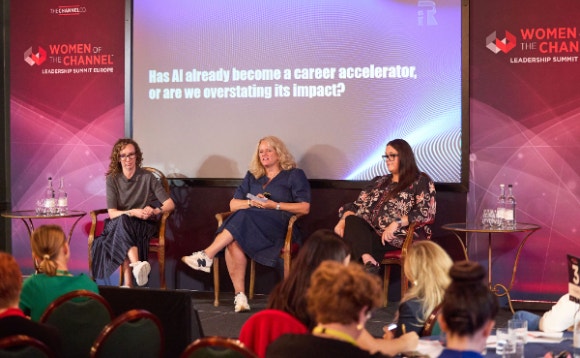
AI is unlocking more opportunities than ever before; improving efficiency, helping make decisions, and taking on admin tasks can all be done with the technology, enabling leaders to do work that is meaningful, rather than repetitive.
However, as leadership is evolving alongside AI, some female leaders warn women are at risk of being left behind.
At a panel at CRN’s Women of the Channel Leadership Summit, Julie Simpson, CEO, ResourceiT Consulting; Rebecca Robinson, senior director EMEA go-to-market, HP; and Nichola Hall, RVP customer success EMEA, Arctic Wolf, discussed how AI is impacting leadership, and what can be done.
Women and AI adoption in the channel
“Harvard Business School is saying that the adoption of generative AI is 25 per cent less in women than it is in men, typically in businesses,” Hall explained.
“And I see that in my team.”
She explained that although Arctic Wolf has invested in Claude licenses, and everyone has a dedicated budget, it is often women who are working below the budget, while men are constantly asking for more tokens.
Hall described the men in her organisation as using AI “fearlessly”.
When these tools are helping leaders and employees get ahead in the workplace, the lagging of adoption from women will have a serious impact down the line.
“We are in early days, and people are using AI in different ways,” explained Robinson.
“Some people use it a lot. Some people use it not at all.
“There is a gulf at the minute as we are so early in the process. But it is absolutely becoming a distinguishing factor.”
Echoing that sentiment, Hall shared where success is actually being found within the workplace, “I think we're seeing success at task level, but I think business-wide success has probably got a way to go.
“I think where people are seeing the most success is when they're not trying to fold AI onto existing workflows, but they’re actually picking a process and redesigning that with AI and being curious about it.”
Some leaders have already been attempting to rectify the adoption gap.
Simpson said, “We are going like the clappers at ResourceiT for AI adoption, and the reason we are doing that is because, as the leader, I said we are doing it.
“I wrote it into everybody's KPIs.
“We employed a technology firm to help us with our processes and how we can leverage it, and I made a huge investment.
“I am convinced that the results we are seeing from our adoption of AI would not have happened if I hadn't made that decision as a leader.
“It is down to the leadership to make the decision.”
Robinson agreed, saying, “Within my organisation, everyone is embracing AI, and actually, it's part of the goals that we set across the organisation to use AI.
“I think it's a real leadership responsibility to ensure that everyone is on the journey, especially as older women are much less likely to adopt AI, and it is really important that we don’t leave them behind.”
Robinson reflected on a successful case study within her organisation, where a more mature member of the team was pushing against AI adoption.
After some coaching and being shown the value of how the technology can transform mundane tasks, “she transformed.”
“I think helping people understand where the use case is and allowing them and giving them the opportunity to embrace it [is important].”
The risks regarding AI adoption within teams
While the drive for adoptions remains a priority, risks remain.
Of course, risks arise when people upload sensitive data to public AI tools, and enough conversations have been had regarding that issue.
However, as women are hesitant to adopt the technology at scale, this can present its own risks.
Hall worries, “The biggest risk for me actually is how the tools are shaped going forward.
“AI needs data, and data is historical, and history is sometimes bias.
“AI will quietly, in the background, recreate what the data tells us, and the data is telling us that the workplace is dominated by men.
“And if, as women, we don't really lean into this and start using and shaping the tools, then what the tools will do is they'll be recreated in the same form that we have historically.”
“I think we can stand up and be counted, and make a contribution.
“And it's only when people like us come together who can make that change,” said Simpson.
Another risk that a panellist mentioned is the infiltration of ‘AI slop’ which is proliferating social media, but also starting to seep into the workplace.
“It actually does exactly the opposite of what we need it to do, which is make things go faster.
“People sending 30-page slide decks that Copilot has created, or a long philosophical email that you're really struggling to get the meaning of has no place in a workplace at all.
“We have to use AI that allows us to be authentically ourselves. We employ people. We don't employ agents.
“We all need to be super discerning when it comes to how and where to use AI, and what your goal is and how you are trying to get there.
“The discernment that you bring to your use of AI will mitigate this risk of just more content, more stuff, and more information that we've all got to try and churn through.”
What will differentiate future leaders?
As AI is democratising access to similar tools, the big question is, what will differentiate leaders?
“I’m super excited about this, because leadership has seemed like a different breed, and I’ve been in the IT industry for 25 years nearly, and leadership never looked like me when I started,” Robinson said.
“We are going through a period of huge change disruption, and the work that we are expecting people to do will shift from being very focused on tasks to much more creative, engaged person-to-person communication.
“All of these things that actually are not a command-and-control style of leadership. I prefer coaching people, bringing the best out of people, recognising the talents that people bring to their jobs that makes the job truly theirs, and really delivering the stuff that is so human.
“I think leadership will become even more so than it is now about coaxing the best out of people, and about leading teams through uncertainty and building resilience and agility.”
Hall echoed the sentiment, “Ultimately, what makes you different as a leader is how you interact on a human-to-human basis, you just use AI to amplify work.”
She continued, explaining that judgement will be one of the new differentiators between leaders.
“I think judgement separates the leaders who are successful and those who aren’t.
“You can passively accept anything that AI gives you and push it back out, but you have to have judgment.
“You have to know what the context is you want to deliver. AI might present you with a lot of information, but you still have to know what the answer is, and you have to develop that.”
How to start using AI
To round off the panel session, each of the panellists shared some practical guidance on how attendees could get started with AI in order to accelerate their careers.
Hall’s advice is, “Don’t start with the tool.
“Find one process that takes time away from people and rebuild it with AI.
“Iterate it, fail, and try again.”
Robinson weighed in, “AI is so deeply personal.
“Find the one thing in your job that you would, if you had the opportunity to, you would outsource to somebody else, and work out how AI can do that for you.
“Your strengths are still your strengths, so use AI to do the stuff that you want to outsource to somebody else.”
Another key theme of the leadership summit was the importance of mentors and sponsors, and when it comes to AI, reverse mentors are becoming key in the older generation adopting AI.
“For women over 45, get a reverse mentor," Simpson advised.
“We are not digital natives, and the people coming into organisations and picking up these tools have a much more natural way of working with it.
“Don’t be shy to get a reverse mentor and embrace what other people can show you.”
As the world around us adapts with AI, leadership will too, and it seems as if the technology will help create more meaningful relationships, rather than divide the workplace.