Opinion: Carbon accounting is moving from hype to habit, just like GDPR
Thomas Mardahl, CEO and founder of Rejoose, outlines the opportunity for the channel as buyers increasingly expect carbon data alongside price and delivery

If you think sustainability is fading from the agenda, think again. It hasn’t disappeared; it has simply matured.
What started as green marketing stories has become a professional discipline embedded in the core of business strategy. Carbon accounting is now climbing the slope of enlightenment, and will soon be as fundamental as financial accounting, and as unavoidable as GDPR.
History repeats itself
We have seen this pattern before.
Financial accounting began as fragmented and voluntary. Over decades, it became standardised, regulated, and digitalised. Today, no business can operate without robust financial systems.
GDPR started with hype, uncertainty, and confusion. Then it faded from headlines and became operational. Today, it has budgets, resources, and dedicated teams. It’s part of everyday life.
Carbon accounting is on the same trajectory, only faster, driven by technology, legislation, and urgency. What feels complex and optional today will soon be routine, embedded in procurement, finance, and leadership decisions.
And here’s the critical point: those who adapt and survive this transition will not only meet compliance, they will gain commercial advantage. They will become trusted advisors, win strategic deals, and secure their place in the future IT ecosystem. Those who ignore it risk becoming obsolete.
From green stories to governance
For years, sustainability was about storytelling and optics. Companies competed to look green, and marketing dominated the conversation. Then came greenwashing scandals, followed by legislation and compliance pressure.
Today, carbon accounting is no longer a PR exercise, it’s a governance requirement. ESG leaders are not storytellers; they are strategists. Their mission is to know the numbers, understand the gaps, and drive action. Sustainability now influences tenders, financing, talent acquisition, and customer trust.
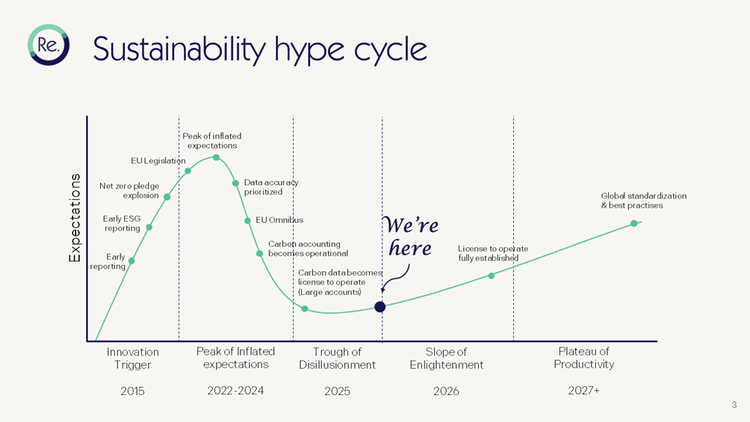
We’ve passed the peak of inflated expectations and the trough of disillusionment. Now carbon accounting is climbing the slope of enlightenment toward the plateau of productivity. Some companies are already there, but most are not. And this is where the IT channel has a unique role to play.
Everyday reality: Why this matters for you
Think about how we respond to an RFP today: pricing, financial options, delivery timelines, and service packages. That’s standard practice. The next phase is adding carbon accounting data to that response. Imagine sending a quote that not only includes cost and delivery but also the carbon footprint of every product and service. Then go further - help the customer interpret that data and improve their sustainability performance. That’s how you earn the status of trusted advisor in 2026.
Here’s the reality: this is already happening, but in the least efficient way. Across the industry, resellers and customers spend hours extracting data from PDFs, copying it into spreadsheets, and formatting it into reports. It’s manual, siloed, unaligned, and often outdated. These hidden costs are enormous, but they remain invisible because most resellers lack a strategy. They do the best they can - piecemeal, without knowledge sharing, and without automation.
Now imagine the alternative: a structured approach where carbon data flows automatically with every transaction. No manual work, no hidden costs, no delays. Both sides benefit:
Customers gain accurate, timely data for compliance and reporting.
Suppliers strengthen relationships, accelerate deals, and position themselves as strategic partners.
Why embracing this is non-negotiable
If your customers have carbon and climate embedded in their strategy, so should you. This is not optional. It’s the next evolution of IT sales and service. And yes, it requires effort - mapping customer needs, asking the right questions, and building capabilities. But the commercial advantages are real, even if they are not immediately visible. Those who embrace this shift will lead. Those who ignore it will lose relevance and, eventually, the invitation to the table.
Sustainability is not a checkbox; it’s becoming the new currency of trust and continuity. Accept that this challenge is not going away. The question is whether you will treat it as a burden or as an opportunity to redefine your role in the value chain.
Below is the Carbon Accounting Hype Cycle, showing the journey from green storytelling to operational ESG leadership and the plateau of productivity.
Carbon accounting is now on the slope of enlightenment, steadily moving toward full integration.