Channel Leaders EMEA 2026: Where partners must invest, and what comes next
This year’s leaders answer where they want partners to invest, biggest challenges, and whether to expect partner rosters to change
AI, security and services are dominating the channel agenda in 2026. But beneath the headlines lies a more nuanced story about how partners must evolve to stay competitive.
But where should partners be placing their bets? And what challenges could derail progress? CRN put those questions directly to this year’s EMEA Channel Leaders.
Their responses reveal a channel at an inflection point, where AI dominates the conversation, but execution, specialisation and long-term value are increasingly defining success.
Top investment areas
More than a quarter (26.7 per cent) of channel leaders named AI as a key investment area for their channel partners in 2026.
The second most given response was security (18.3 per cent), with services (11.7 per cent) rounding up the top three.
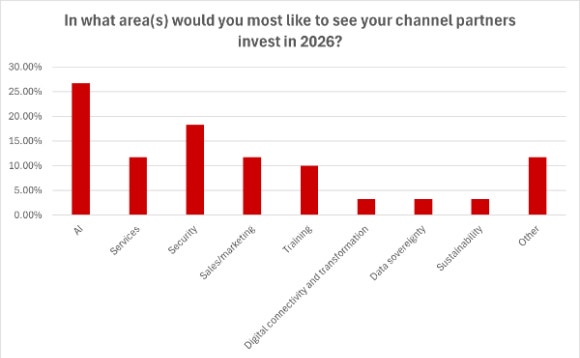
Answers that fell under ‘Other’, also making up 11.7 per cent of responses, included:
- Subscription-based models
- Multi-workload solutions
- Owning the full customer lifecycle
- Winning net-new end-customers
- Backup storage
- Strategic expansion of distribution partnerships
- Modernising the SOC and building services that support agentic security use cases
Artificial intelligence
Fear not, the most popular answer given by our channel leaders wasn’t left at a mere two letters.
Respondents pointed to a growing need for expertise across AI security, agentic AI, and AI-enabled solutions, with a strong emphasis on governance, data readiness, and real-world use cases.
“As AI agents become increasingly autonomous and integral to business operations, demand for context-aware, scalable security solutions will grow. Partners should also focus on preventing data leaks and protecting sensitive information, ensuring AI systems are secure by design and compliant with privacy regulations as they scale, helping avoid the major cyber incidents or AI failures seen in the past year,” said one leader.
“The channel should invest in building early expertise in AI security as it emerges as a distinct and critical category. As organisations adopt agentic and autonomous AI platforms, partners will need to understand new risks around data access, model behaviour, and governance,” answered another.
Leaders also stressed the importance of moving beyond experimentation towards commercialisation, with partners expected to build repeatable, services-led AI offerings.
“Partners who build structured AI governance, data readiness, and real-world use cases will lead the next growth wave.”
AI readiness, advanced infrastructure, and lifecycle services were also tipped as key investment areas.
“Growth will come from AI-enabled components, hybrid cloud platforms, UCaaS, CCaaS, and professional AV solutions. Differentiation will be driven by services delivery, vertical expertise, and the ability to link technology to measurable customer outcomes and recurring revenue.”
Alongside technical capability, some respondents highlighted the need to retain a human-first approach.
“While AI can streamline operations and improve efficiency, partners should ensure it doesn't reduce meaningful interaction with customers. Trust, guidance, and context still matter. Partners that keep relationships at the forefront, combining AI-driven insights with human expertise will be best positioned to deliver real value and differentiate themselves in an increasingly competitive market,” one wrote.
Technical and sales upskilling were both seen as critical to capitalising on the opportunity.
“Often forgotten sales teams need to evolve into new ways of consultive selling approaches to successfully articulate the challenge and opportunities of AI to end customers,” said one leader.
Security
Following the unprecedented volume of high profile cyberattacks last year, it comes as no surprise that security is viewed by channel leaders as a top investment area for their channel partners.
And like AI, several layers of security were named.
“Cyberattacks continue to accelerate in scale, sophistication, and impact, affecting organisations of every size. Customers are increasingly seeking platform-based security that reduces complexity and delivers outcomes, not tools. In 2026, we want partners to invest in simplifying security solutions that are easy to sell, deploy, and operate,” answered a 2026 EMEA channel leader.
“We'd like to see our channel partners continue investing in data security, deeper platform integration, and process automation. These areas are key to reducing operational complexity, improving service consistency, and protecting customer environments as threats evolve,” another added.
Leaders also pointed to the growing importance of managed and services-led security models.
“Building and scaling managed security services will be critical to deepening customer engagement and reinforcing partners' roles as trusted advisors,” they said.
“In parallel, partners should invest in AI-ready security practices that help customers secure and operationalise emerging technologies. By using data and analytics to identify opportunities and guide customer conversations, partners can strengthen relationships, improve outcomes, and drive sustained, mutual growth.”
Services
Services remain a key battleground for differentiation, particularly as partners continue shifting towards recurring revenue models and deeper lifecycle engagement.
Leaders consistently pointed to professional and managed services as critical to helping customers modernise infrastructure while unlocking higher-margin opportunities for partners. Migration expertise, in particular, is seen as essential to accelerating adoption and reducing risk, while strengthening long-term customer relationships.
“In 2026, I would like to see our channel partners continue investing in professional services capabilities. As customers modernise infrastructure and move away from legacy architectures, partner-led migration expertise will be critical to accelerating adoption, reducing risk, and delivering consistent outcomes. Strengthening these capabilities will allow partners to capture higher-value services revenue while deepening long-term customer relationships,” said one leader.
There is also a growing recognition that services require a cultural as well as technical shift. Leaders highlighted the need for better enablement of sales teams to position services effectively, as partners move away from one-off hardware transactions towards ongoing value delivery.
“Training and development of sellers to better understand the opportunity for extended support and complimentary managed and professional services. Most channel partners are realising that a greater focus on services is necessary to diversify their business. New hardware sales are less a destination and more a step in a continuous lifecycle journey that drives value for end users by providing novel solutions to maximise IT budgets.”
Security-led services are another major opportunity, particularly in regulated industries and across Europe, where compliance requirements are driving demand for more sophisticated managed offerings. Leaders pointed to MSSP expansion as a clear growth area, especially when combined with strong regulatory expertise and outcome-driven delivery.
“In 2026, I would most like to see our channel partners invest in extending their MSSP offerings, with a strong focus on Europe. There is a significant opportunity to build new, differentiated services driven by regulatory-led transformation programmes, particularly across financial services and large enterprises. Partners that combine deep regulatory understanding with managed, outcome-driven security services will be best positioned to support customers navigating increasing compliance demands, while also creating sustainable, recurring revenue aligned to a modern SaaS delivery model.”
AI tops list of partner challenges in 2026
CRN also quizzed the leaders on what they think the biggest challenge will be for channel partners this year.
Despite being the top investment priority, AI also emerged as the single biggest challenge facing partners in 2026.
Leaders pointed to a wide range of AI-related pressures, from keeping pace with rapid innovation to building profitable, scalable practices.
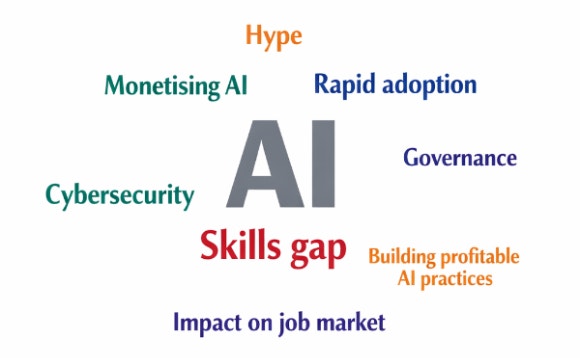
Skills shortages were a recurring concern, alongside difficulties in monetising AI and cutting through market hype.
Governance and risk management are also rising up the agenda, particularly as AI introduces new cybersecurity and compliance challenges.
Beyond AI, cybersecurity itself remains a moving target, with partners needing to keep up with the pace of innovation while responding to increasingly sophisticated threats.
Economic pressures are also expected to weigh heavily. Budget constraints and rising costs were frequently cited, alongside ongoing inflation in hardware pricing.
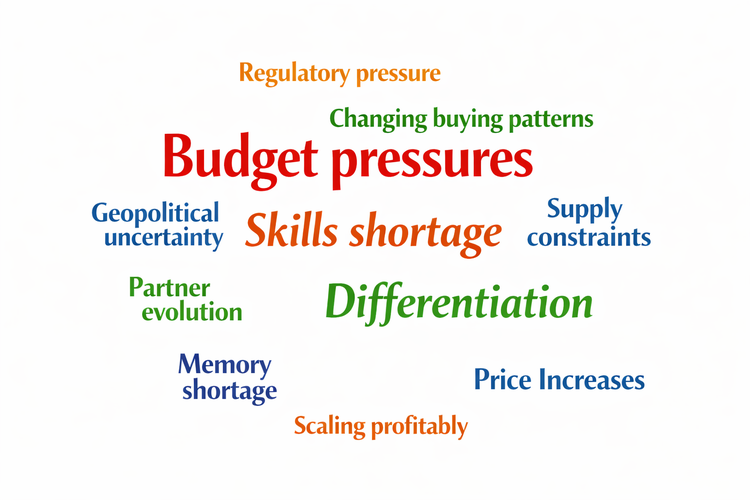
At the same time, partners face mounting regulatory complexity, including evolving data sovereignty requirements and legislation such as NIS2 and the UK Cyber Security & Resilience Bill.
Skills shortages extend beyond AI, with many leaders highlighting a broader talent gap as a barrier to growth—particularly in high-demand areas such as cybersecurity and advanced services.
Other key challenges include differentiation in a crowded market, shifting customer expectations, and the continued transition from transactional resale to services-led and subscription-based business models.
Geopolitical uncertainty and supply chain constraints were also flagged as ongoing risks, while some leaders noted the difficulty of scaling profitably while evolving into higher-value, strategic partners.
Will vendor channel rosters increase or decrease in 2026?
When asked whether they expected the number of channel partners they work with to increase, stay about the same or decrease within the next 12 months, most channel leaders (80.3 per cent) said increase.
Several reasons were given for the expected rise, including to capture market share, to grow internationally, to heighten brand awareness, and a strong belief in their own partner programmes and offerings.
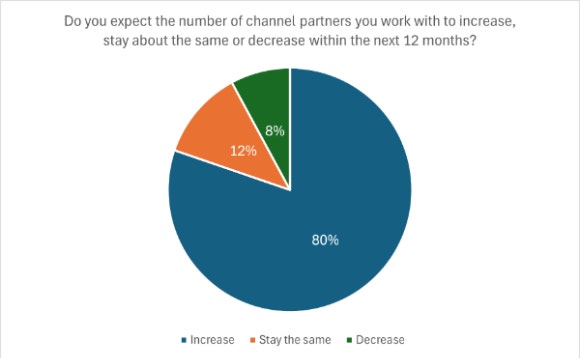
Meanwhile, 11.8 per cent expected the number to stay the same, owing to aligning with the right partners and deepening engagement and enabling success with existing partners.
Only 7.9 per cent of respondents answered decrease.
Some leaders plan to strategically reduce their roster to focus on partners who can build profitable, long-term relationships having worked with too many transactional partners, which diluted focus and impact.
While others are evolving their partner ecosystem to better reflect market realities and shared capabilities, resulting in a more optimised network of distributors.
CRN’s outlook
Taken together, the results paint a picture of a channel in transition. While AI dominates both opportunity and risk, the broader shift towards services, specialisation and long-term customer value is unmistakable.
For partners, success in 2026 will hinge less on what they sell, and more on how they evolve—balancing innovation with execution in an increasingly complex and competitive landscape.