Robotics giant KUKA knocks on the IT channel’s door
Industrial robotics giant KUKA is recruiting traditional IT partners to sell and deliver physical AI, promising new revenue opportunities as robotics moves beyond its established specialist channel
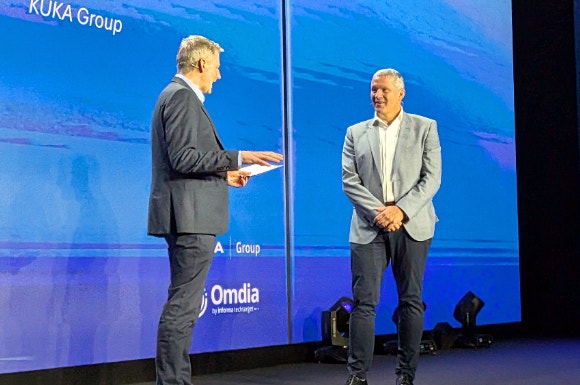
One of the world’s oldest industrial robotics companies recently turned up at an IT channel conference looking for partners with an attractive pitch: it doesn’t have an established IT channel to compete with them.
KUKA Group, the 126-year-old German automation company, is looking to recruit IT resellers and solution providers as it expands into physical AI, bringing artificial intelligence into robots and machines that operate in the real world.
“We have no channel conflict because we have no channel,” CEO Christoph Schell told partners at Canalys Forum EMEA in Barcelona.
Schell, a former HP and Intel executive, said advances in AI are making robotics easier to deploy across a wider range of industries, creating an opportunity to build a new partner ecosystem.
“When you work at HP and Intel, channel is like breathing,” he said.
But KUKA has traditionally relied on specialist industrial integrators, many of which serve only one or two customers. That model works for highly customised factory installations but limits the company’s ability to expand.
“Now it’s the right time to build a channel, and I do see huge adjacencies for the IT channel to be that channel,” said Schell. “And we are here to recruit.”
KUKA signs TD SYNNEX as distribution partner
The company has signed a distribution agreement with TD SYNNEX, giving IT partners access to its autonomous mobile robot portfolio.
The initial rollout covers the UK, France, Spain and Benelux, with additional markets planned in the coming quarters. TD SYNNEX will provide technical training, enablement and demand generation support to help partners build robotics practices.
Schell said KUKA is also developing its partner programme, with Schell saying that it wants input from prospective partners rather than imposing a rigid structure from the outset.
The potential market is substantial. Omdia forecasts that physical AI will grow from an $81.4 billion market in 2025 to $1.145tn by 2035. It also expects autonomous robot adoption in customer service, logistics and manufacturing to reach 35 percent by 2030, up from 14 percent today. Meanwhile, global humanoid robot shipments are forecast to exceed 700,000 units by 2030.
Physical AI, real-world opportunities
For Schell, physical AI represents the next stage of an industry that has traditionally relied on robots performing repetitive, pre-programmed tasks. Adding cameras, sensors and AI models allows machines to interpret their surroundings and make decisions about how to complete physical tasks.
He described the development as another major transition for the IT industry, following hardware sales, software-defined infrastructure and the infrastructure buildout supporting AI.
“AI is in it, but the output is physical,” he said.
Schell sees opportunities for partners in networking, particularly as mobile robots require connectivity, as well as warehouse automation, logistics and manufacturing.
But he stressed that partners wouldn’t necessarily need to become specialist robotics integrators to participate. Some could sell equipment, while others could develop applications, provide integration services or participate in recurring revenue models.
“You will sell a platform that connects a deterministic world to an AI world,” he said.
KUKA is open to licensing, robotics-as-a-service and outcome-based commercial models, where customers pay for work completed rather than simply purchasing equipment.
KUKA: ‘I need a channel’
KUKA generates approximately €4.5bn in annual revenue, according to the CEO, but its existing sales model remains largely direct.
“I probably cover 15 per cent of my market. I need a channel to help me with coverage,” said Schell.
He also suggested that the margins available in industrial automation could be attractive compared with those traditionally available in IT.
“Don’t worry about margins. They’re much healthier than what I know from my past,” he told attendees.
However, entering the market will require investment from partners. Schell said prospective recruits will need to undergo training and certification, understand how robotics systems operate and develop the ability to identify customer opportunities.
Deployment also presents different challenges from traditional IT projects, including physical integration into factories and warehouses, as well as operational safety requirements.
Nevertheless, Schell said he’s not restricting recruitment to partners with existing manufacturing or operational technology expertise.
“I’m more looking for partners that are curious, partners that want to expand, want to learn a new trick, want to leverage some of your capabilities but build new capabilities, partners that want to grow with margin.”
Schell is already looking ahead to what that new relationship could become.
“I’m very happy to be here a year from now, and say now we’re channel first,” he said.