CRN Market Signal: What UK and US IT spending intent reveals about the future of the channel
In this new quarterly thought leadership op-ed, CRN chief content officer Stuart Sumner will share our latest global research. In this edition, end-user spending-intent data from UK and US IT leaders reveals that the future of the channel may not be about selling more AI at all

Artificial intelligence may dominate headlines but the latest CRN research from the UK and US suggests a more nuanced reality. AI is undeniably shaping technology strategy, yet it is not where most organisations are spending most of their money. Instead, cybersecurity, cloud infrastructure, governance and operational efficiency continue to command the largest shares of IT budgets.
For channel partners, that distinction matters.
This latest CRN research reveals two markets pursuing similar goals but through different routes. Both see AI as strategically important. Both expect technology budgets to grow. Both are looking for productivity gains and operational improvements. Yet the opportunities emerging for solution providers, MSPs, VARs and consultants look markedly different on either side of the Atlantic.
AI may dominate the conversation, but not the budget
One of the most surprising findings is how modest AI spending remains.
Nearly half of UK respondents allocate less than 5 per cent of their IT budget to AI-related initiatives, while nearly 62 per cent of US respondents do the same. In both markets, AI remains a relatively small budget category compared with cloud services and cybersecurity.
Chart 1: AI remains a small budget item
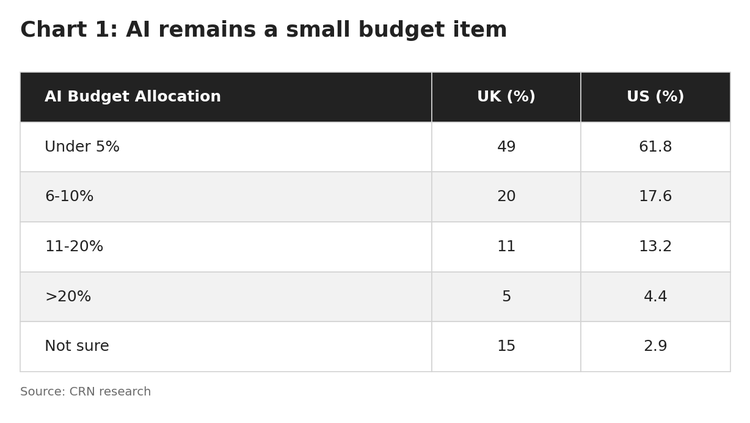
The implication for channel partners is significant. Customers are not looking for dramatic AI transformation programmes, they are looking for practical outcomes. The strongest demand is centred around employee productivity, business process automation, IT operations and data analysis rather than speculative moonshot initiatives.
In other words, organisations want partners who can connect AI to measurable business value.
America's AI advantage is governance, not adoption
At first glance the US market appears further ahead in AI maturity, but the data suggests something more nuanced.
The gap is not primarily about deployment. Both countries remain largely in evaluation, pilot or limited-production phases. The real difference lies in governance.
US organisations are substantially more likely to have established AI frameworks, formal policies, governance committees and audit controls. They are investing heavily in the organisational infrastructure required to scale AI safely.
Chart 2: AI governance maturity
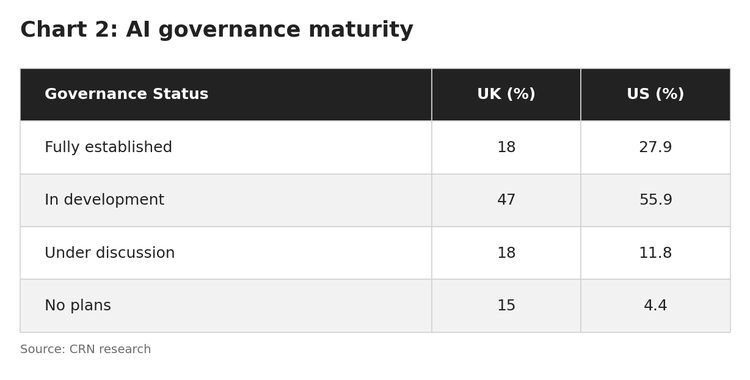
For North American channel partners, this represents a substantial services opportunity. Organisations increasingly need guidance around governance, policies, risk management, compliance and responsible AI adoption. The AI software itself may become commoditised, but governance services are likely to remain high-value engagements.
The UK market presents a different opportunity.
British organisations appear more focused on immediate efficiency gains and cost management. UK respondents show stronger interest in software development use cases, cost reduction and operational optimisation. The emphasis is less on transforming the organisation and more on improving it.
Security remains the biggest spending priority
If AI is the headline story, cybersecurity remains the underlying business reality.
The research repeatedly shows security outranking or matching AI as a major technology priority. Even among organisations actively investing in AI, cybersecurity continues to attract larger and more established spending commitments.
The US market appears particularly security-focused. American organisations dedicate larger proportions of their budgets to cybersecurity and identify cyber resilience as a leading investment area for 2027.
Chart 3: Cybersecurity budget allocation
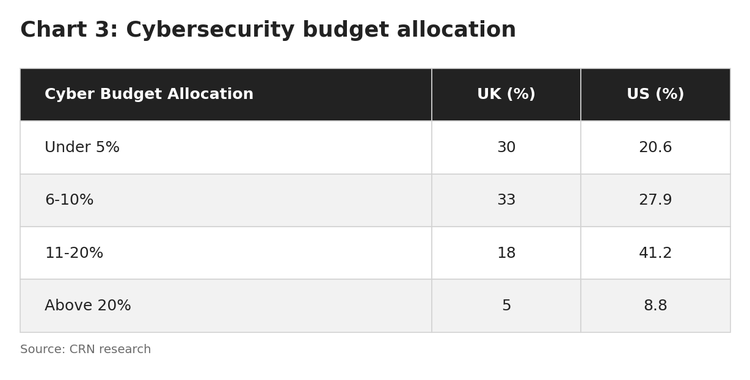
For the channel, the implications are straightforward. Security remains where customers are writing substantial cheques.
AI might open the door, but security frequently closes the deal.
The most important channel story is hidden in partner preferences
Perhaps the most revealing finding in the entire study has nothing to do with AI. It is the way organisations intend to consume technology.
American respondents demonstrate far greater reliance on MSPs, VARs, security consultants and AI consultants. British respondents, by contrast, show stronger preference for direct engagement with cloud providers and specialist technology consultants.
Chart 4: Partner ecosystem comparison
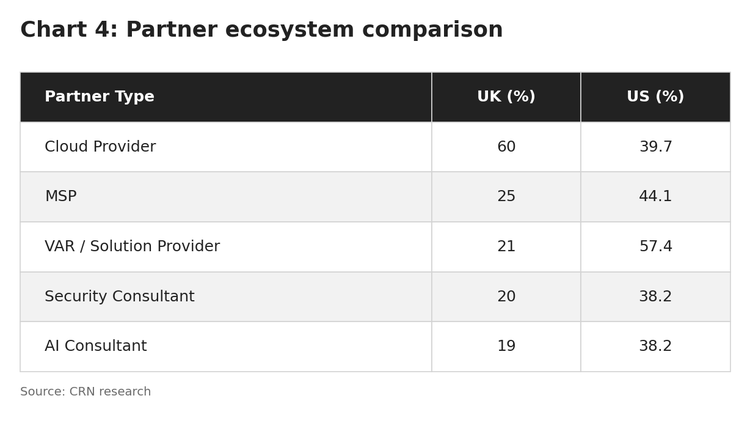
In the US, partners increasingly function as operational extensions of customer organisations. Their role extends beyond implementation into governance, optimisation, compliance and ongoing management.
In the UK, partners remain influential but are more often helping customers optimise technology investments rather than assuming ongoing operational responsibility.
APAC adds a third channel model
APAC complicates this transatlantic picture. It is too diverse to treat as a single comparable market, but CRN research suggests that its defining characteristic is not simply AI adoption, rather the simultaneous construction of the infrastructure, skills and governance required to support it.
Singapore represents the mature end of that spectrum. Research covering its financial institutions found nearly two-thirds already using AI in production, while 73 per cent had deployed or improved AI applications in payments. Yet 54 per cent cited specialist talent shortages and 52 per cent budget constraints, creating demand for partners able to combine cloud, security, compliance and operational expertise.
India presents a different opportunity. Its IT spending is expected to reach $176.3bn in 2026, alongside a substantial pipeline of AI infrastructure and data-centre investment. Here the channel opportunity begins below the application layer: GPU systems, high-density infrastructure, cooling, cloud operations, security monitoring and data governance.
Across Southeast Asia, meanwhile, sovereignty and localisation are becoming commercial requirements rather than policy abstractions. The result is a third channel model alongside America’s services-intensive ecosystem and Britain’s platform-led pragmatism: an APAC market in which partners increasingly act as infrastructure builders, regional delivery engines and ecosystem orchestrators.
Different routes to the same destination
Despite these differences, the US and UK markets share more similarities than differences.
Both continue to wrestle with AI readiness. Both cite skills shortages as a concern. Both are modernising infrastructure while trying to control costs. Both expect technology budgets to increase, but generally in measured increments rather than dramatic jumps.
Most importantly, none of the research shows runaway AI spending. Instead, what emerges is a picture of increasingly mature buyers.
These organisations are no longer interested in technology for technology's sake. They want business outcomes. They want resilience. They want governance. They want efficiency. They want measurable returns.
For channel partners, that may actually be the most encouraging conclusion of all.
The next wave of growth is unlikely to come from selling more software licences. It will come from helping customers manage complexity: governing AI, securing environments, modernising infrastructure, controlling cloud costs and proving business value.
The data suggests organisations on both sides of the Atlantic have already decided AI belongs in their future. The crucial question is no longer whether they will adopt it.
It is who they trust to help them make it work.