Up to 30 per cent of channel partners will disappear or transform by 2030
AI is set to radically reshape the IT channel over the next four years, with established business models under pressure and new competitors threatening partners that fail to adapt
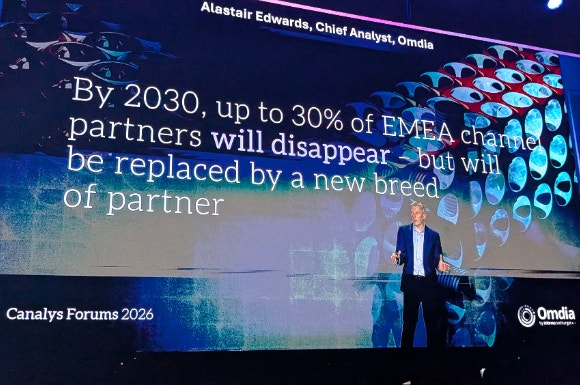
A significant number of channel partners will disappear or no longer exist in their current form within a few years, according to analyst firm Omdia.
Speaking at Canalys Channels Forum in Barcelona, Omdia chief analyst Alastair Edwards warned that AI, automation and changing customer demands are bringing major disruption to the channel.
“By 2030 we expect that up to 30 per cent of the existing partner base is not going to exist in its current form,” said Edwards. “There’s going to be a portion that are going to disappear because they can’t transform quickly enough.”
The prediction doesn’t mean nearly a third of partners will necessarily go out of business. Some will exit the market, others will transform their operations, while new competitors will challenge established providers.
But Edwards warned that partners must begin preparing now if they want to remain relevant.
He pointed to management consultancies expanding into technology implementation, while traditional resellers are building consulting capabilities to maintain influence over customers.
Meanwhile, a new generation of AI-native consultancies is emerging, focused on helping organisations manage the business changes associated with AI adoption.
Importantly, these companies may lack the technical capabilities to deploy complex AI platforms themselves, creating opportunities to collaborate with established providers.
“We’re seeing these different categories increasingly blend around the edges,” said Edwards.
Traditional systems integrators are also under pressure. Some are missing out on major datacentre deals despite advising customers on those investments, while automation threatens labour-intensive delivery models.
MSPs face a more fundamental overhaul
Omdia research director Robin Ody said the disruption could fundamentally change what it means to be an MSP.
“It’s the model change. It’s what the MSP even looks like in five to 10 years’ time. It may be unrecognisable, certainly for some of them,” he said.
Ody identified three areas where MSPs are investing: using AI to improve internal operations, developing AI services for customers and changing their underlying business models. He also said prospective buyers of MSP businesses are now paying much closer attention to their AI capabilities.
“At the beginning of the year when I asked MSPs whether or not the people that were acquiring them were asking about AI, every one of them in this region said not really. Now every one of them is saying yes.”
He described the ideal future MSP model as “AI integrated, security capable, high recurring revenue”.
Omdia predicts that valuations will become the biggest underlying driver of AI adoption among MSPs between now and 2030.
However, Ody cautioned that the most advanced examples remain a small minority of the market.
“There is a real adoption to revenue gap, so we have to make sure that people understand this is our future, not necessarily our present,” he said.
Collaboration becomes essential
The changing landscape is also driving greater collaboration between partners.
Few businesses can provide every capability themselves, making specialist partnerships increasingly important. Edwards highlighted partnerships between systems integrators, resellers, telecoms providers and distributors as customers demand increasingly complex AI solutions.
“Not all of you are going to be able to do this, but you’re going to be working with partners who are helping you to deliver this complex stack to enable customers to embrace AI,” Edwards told partners.
“Some of you will be part of that new breed of partner.”