Industry Voice: How does the remaining residual value of IT assets directly contribute to sustainability?
Circular IT group implement smart ITAD strategies that keep reuse, resale, and residual value on the table.
As someone in IT, you’ve seen and heard the sustainability pitch a thousand times.
Truthfully, if sustainability costs more, it isn’t commercially viable, and no sustainable wins will be gained.
That’s exactly why the residual value of IT assets matters. It’s a practical way to improve ROI while remaining safe, secure, and compliant, with sustainability as a by-product.
Residual value is an ROI lever, not a nice-to-have
Most organisations treat end-of-life IT as solely security management:
- “Is the data gone?”
- “Are we compliant?”
- “Can we prove it?”
Being safe, secure and compliant is vital. But if you stop there, you leave value behind.
Residual value means the remaining usable, recoverable, or tradable value inside hardware when it leaves your environment. That value can show up as:
- Redeployment or reuse
- Remarketing revenue
- Buy-back credit
- Parts harvesting (where appropriate)
- Donation routes that provide tax and social benefits
- Verified reporting that supports ESG and CSRD narratives
Reuse is usually the most sustainable option
When you shred or destroy assets too early, you delete that value permanently. And you often replace it with new purchases that carry financial and environmental costs.
Destruction and recycling always has its place. But if a device still works, reuse beats recycling.
Why? By securely wiping and reusing hardware, a device stays in use longer, and you reduce the total cost of ownership.
The additional sustainability element comes from avoiding buying a newly manufactured device. You extend the lifecycle with minimal additional energy input. You reduce emissions. You reduce procurement pressure.
In other words, you improve sustainability by doing the most commercially sensible thing first.
Security does not need destruction
A common blocker sits in many security policies: “shred by default.”
Modern ITAD does not force a trade-off between sustainability and security. It demands a better process.
Circular IT group supports data erasure, where policy allows, which keeps reuse and resale on the table. And when customers must shred, on-site or off, we handle the chain of custody and ensure compliant and controlled downstream recycling routes.
So, the decision becomes clearer:
- Wipe + reuse where policy permits, because it preserves value.
- Shred + recycle when required, because compliance comes first.
The hidden cost of “quick disposal”
IT asset disposition can look like the most suitable option for compliant disposal, but the hidden cost of quick disposal looks very different when you include:
- Lost resale value
- Lost buy-back opportunities
- Higher replacement spends
- Extra logistics
- Increased Scope 3 footprint from manufacturing new hardware
- Missed donation routes with reporting value
That’s why a reuse-first ITAD strategy often wins financially, even before you consider sustainability reporting.
And for resellers and service providers, residual value also protects margin. When you recover value and build circular services into deals, you stop competing on hardware price alone.
What “value recovery” looks like in practice
Residual value is a set of lifecycle choices, supported by the right services.
Circular IT group works across the full lifecycle, including:
1) Secure collection and chain of custody
We manage logistics and custody controls, so assets remain traceable and auditable.
2) Certified data wiping and evidence
We provide documented, defensible proof of erasure and processing outcomes.
3) Testing, grading, refurbishing and upgrades
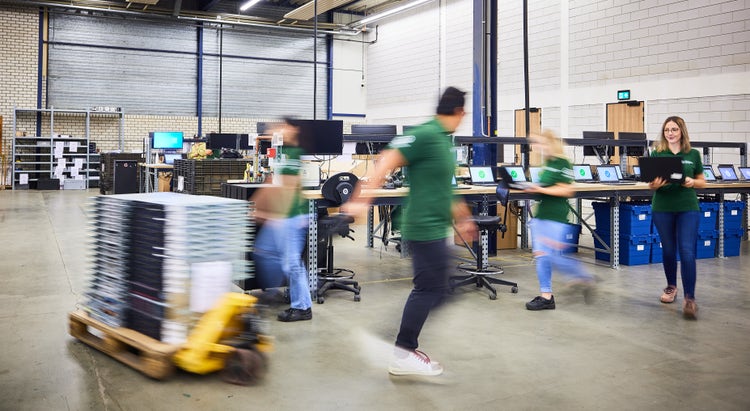
We keep assets in use longer through repair, upgrades, and refurbishment workflows.
4) Remarketing, buy-back and value recovery
We help organisations recoup residual value through structured buy-back routes.
5) Donation programmes that create measurable outcomes
Where assets do not need destruction, we support donation routes that extend life and generate social impact, locally or internationally, while maintaining security and reporting discipline.
6) Certified recycling when an asset reaches true end-of-life
When reuse stops, we ensure compliant, controlled and cost-efficient processing.
Why sceptical organisations change their mind
The channel tends to resist sustainability messaging for good reasons:
- It often feels like extra admin.
- It often sounds like marketing.
- It often ignores cost and risk.
Sustainability becomes credible when it meets three conditions:
It reduces cost.
Residual value reduces net IT spend through lifecycle extension and value recovery.
It reduces risk.
Certified erasure, controlled custody, and auditable reporting reduce compliance exposure.
It reduces effort.
A partner that runs end-to-end IT asset disposition and lifecycle management removes operational burden from internal teams and reseller delivery.
That is where circular IT stops being a moral argument and becomes a strategic advantage.
This article is sponsored by Circular IT Group.