Partners outpaced by end users on sustainability demands, says channel leaders
CRN’s 2026 EMEA Channel Leaders survey reveals sustainability is becoming a major factor in partner and customer buying decisions
Sustainability is increasingly influencing buying decisions across the channel, according to CRN’s 2026 EMEA Channel Leaders survey, with vendors embedding ESG initiatives, energy efficiency and circular economy programmes more deeply into partner strategies.
CRN asked the 2026 Channel Leaders three questions: Is sustainability important to your end-users when they are considering products that you offer? Is sustainability important to your partners when they are considering products that you offer? And how are the leaders themselves incorporating it in their respective organisations?
This is the third article in a series from CRN’S 2026 EMEA Channel Leaders. Read the first here and second here.
The data reveals that this year’s cohort think sustainability is further down the agenda for channel partners buying IT compared to end users.
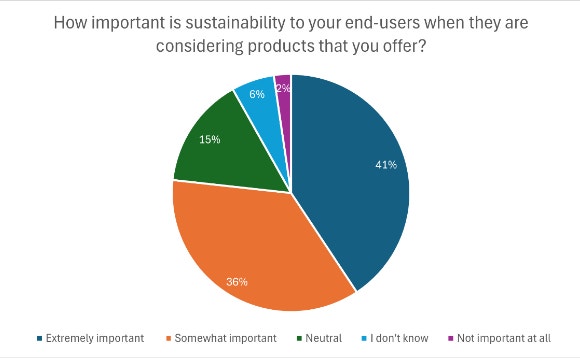
Among surveyed leaders, 41 per cent said sustainability is extremely important to end users when considering the products they offer, while a further 36 per cent described it as somewhat important. Only two per cent said it was not important at all.
The picture among partners was similarly strong, although slightly more measured.
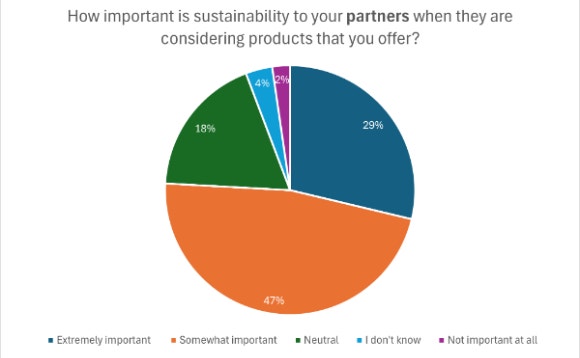
Nearly half (47 per cent) said sustainability is somewhat important to partners evaluating products, while 29 per cent said it was extremely important.
Another two per cent also said it was not important at all to channel partners.
What are channel leaders doing about sustainability?
A recurring theme throughout the responses was the growing alignment between sustainability goals and operational efficiency.
Many organisations are focused on helping customers reduce power consumption, cooling requirements, datacentre footprints and hardware waste while also lowering costs.
“Sustainability is a core pillar of our product and channel strategy. Our partners play a central role in helping customers achieve their ESG goals through our energy-efficient portfolio, a model built on non-disruptive upgrades and a no-data-migration promise,” said one respondent.
“By extending system life cycles and cutting waste, we help customers dramatically reduce their environmental footprint while improving ROI. Notably, our all-flash arrays consume up to 85 per cent less power than those of our competitors and use 85 per cent less water, arming partners with a unique advantage from a sustainability perspective.”
Another leader highlighted infrastructure efficiency improvements through product engineering.
“Sustainability is an integral part of our channel programs via our products/solutions. Our products that our channel partners resell help our mutual end users save costs of floor space by consolidating arrays along with power and cooling.
“Our products/solutions continue to reduce carbon emissions, reduce waste, and improve energy efficiency. We have combined environmental impact and economic efficiency in a unique way to enable partners and customers to lower costs.”
Elsewhere, sustainability was directly tied to hardware optimisation.
“We have been reducing the rack space footprint and the power and cooling requirements with each release of appliance models.”
Networking and cloud firms also framed sustainability through efficiency gains and scalable delivery models.
“We're embedding sustainability into our channel program by prioritising energy-efficient solutions and lifecycle optimisation in partner enablement. Our initiatives include training partners on green networking practices and promoting low-power optical/IP technologies helping partners deliver value while reducing environmental impact,” one respondent shared.
Another added: “We are committed to reducing the environmental impact of our offerings by increasing efficiency and scalability with cloud-based solutions. Most of our products are delivered electronically, eliminating the need for packaging.
“Our shipping materials are reused until they eventually get recycled. We have a company-wide program to recycle consumables, reduce waste, and practice energy reduction wherever possible. This is influencing the way we are working and collaborating with the partner ecosystem.”
ESG enablement becomes a key channel priority
The survey also revealed a major focus on sustainability training, accreditations and partner enablement.
Several companies are now rolling out ESG-focused certifications and educational programmes to help partners navigate customer sustainability conversations more effectively.
One respondent said:
“To further empower partner leadership in sustainability, we offer resources like our sustainability and ESG competency, enabling partners with the knowledge and tools to deliver impactful solutions for business, people and the planet.
“We have expanded enablement with sustainability and ESG solutions competency. We also offer third-party corporate impact workshops, including a Canalys course on ‘How IT partners can accelerate and commercialise sustainability.’ Together with on-demand learning, these pathways validate expertise and help partners achieve measurable, customer-aligned outcomes.”
Another leader said:
“We offer a sustainability specialist enablement module to equip sales and technical partners with the knowledge and tools to lead impactful ESG conversations. The module provides partners with the necessary tools and knowledge to navigate this conversation successfully with new buyer personas, address key environmental concerns, and evaluate cost savings.
“Upon completing the module and associated assessment, partners will receive a sustainability specialist badge, and we will also plant a tree in their name in partnership with our Pure Good Foundation.”
Circular economy initiatives gain traction
Lifecycle management and circular economy programmes featured heavily throughout the responses, reflecting growing demand for sustainable infrastructure consumption models.
One respondent described sustainability as a practical and measurable initiative for partners:
“Sustainability will be a major focus for us in 2026. We are actively incorporating this into our channel programme by launching a tree initiative within our global partner programme, giving partners a simple and meaningful way to contribute to positive environmental impact.
“Alongside this, we continue to prioritise sustainability when selecting datacentre locations wherever possible, including the use of renewable energy sources. Our aim is to make sustainability practical, measurable, and aligned with how partners operate and grow their businesses.”
Others focused on operational processes and supply chain accountability:
“Adherence to EU Sustainability Standards: Aligning our processes and policies with the regulatory requirements set by the EU to ensure full compliance.
“Carbon Emissions Reduction: Implementing initiatives to lower our carbon footprint through more efficient operations and greener practices.
“Transparency and Reporting: Enhancing our reporting frameworks to provide clear, accurate, and regular updates on our sustainability performance.
“Responsible Supply Chain Practices: Ensuring our suppliers follow ethical, sustainable standards that align with our environmental goals.”
Sustainability broadens into social impact and resilience
Several firms broadened the sustainability conversation beyond emissions and efficiency to include social impact, cybersecurity resilience and corporate responsibility.
“We embed sustainability into our channel ecosystem primarily through partner-enabled community impact and responsible business practices,” said one leader.
“Partner-led corporate social responsibility and education initiatives: through the Foundation #TeamUp program, our partners are invited to participate in practical community initiatives, including building schools in underserved regions and delivering cyber safety classes in local communities.
“We provide partners with free training resources and ready-to-use educational assets to run their own local cybersecurity education activities in local schools (cyber hygiene, cyberbullying, safe internet practices), making it easier for MSPs to deliver measurable social impact without heavy lift.”
Another cybersecurity-focused vendor also linked sustainability directly to digital protection:
“Our mission is to secure the world against cyber threats, putting sustainability at the heart of our business. Together with our partners, we empower our customers with solutions that help them secure their critical access, environments, data and privacy in a world that sees the frequency and severity of cyberattacks increasing quickly.”
CRN’s take
Taken together, the findings show a channel market where sustainability is increasingly tied to measurable business outcomes rather than standalone ESG messaging.
Whether through energy-efficient infrastructure, circular economy services, renewable-powered datacentres or sustainability-focused partner enablement, vendors are increasingly positioning ESG initiatives as a route to profitability, resilience and long-term competitive differentiation.