What the 2026 EMEA Channel Leaders really think of the channel's preparedness for AI
On Day 1 of AI Week, CRN's EMEA Channel Leaders suggest the channel is still finding its feet when it comes to selling AI

It’s Day 1 of CRNAI Week, a global content project where CRN editorial will go all-in on AI.
Across our global newsrooms in the UK, US, Germany, Singapore, Australia and India, our journalists will publish a daily deep dive AI feature on channel opportunities for this technology.
In this CRN UK feature, we’re looking to our own data set and research from
CRN Channel Leaders EMEA 2026.
Artificial intelligence has dominated boardroom conversations, vendor strategies and technology investment plans over the last two years. But how prepared is the channel to capitalise on the opportunity?
CRN's 2026 EMEA Channel Leaders survey reveals an industry that is optimistic about AI's potential but realistic about the challenges that remain.
Vendors are increasingly bringing monetisable AI offerings to market through partners, yet concerns around partner readiness, skills gaps and customer understanding continue to slow adoption.
This is the final article in a series from CRN’S 2026 EMEA Channel Leaders. Read the first here, second here and third here.
The channel gives itself a cautious pass mark
When asked to rate the IT channel sales community's preparedness to sell AI-related products on a scale of one to seven, respondents delivered a broadly positive but measured verdict.
The most common response was four out of seven, selected by 31 per cent of respondents, closely followed by five out of seven at 28 per cent. Meanwhile, 19 per cent opted for three out of seven.

At the other end of the spectrum, only 11 per cent rated preparedness at six or seven, while ten per cent scored it at one or two.
The results suggest the industry believes progress is being made, but that AI expertise is far from universal across the partner ecosystem.
Monetisable offerings are already here
While channel readiness remains a work in progress, vendors are moving quickly to equip partners with AI solutions they can take to market.
Almost half (44 per cent) of respondents said they already have AI offerings that partners can actively monetise. A further 28 per cent are actively developing AI propositions, while 16 per cent have partnered with specialist technology providers to deliver AI solutions through the channel.
Only six per cent said they are still exploring what their AI offerings could look like, with an identical proportion reporting they currently have no AI offerings available.
The findings indicate that most vendors have moved beyond experimentation and are now focused on commercialisation.
Microsoft leads the AI ecosystem
The survey also highlights the technology vendors shaping the channel's AI landscape.
Microsoft emerged as the clear leader, with 21 per cent of respondents identifying Copilot as a key AI partnership. Amazon Web Services followed with 13 per cent of mentions, closely ahead of NVIDIA with 12 per cent.
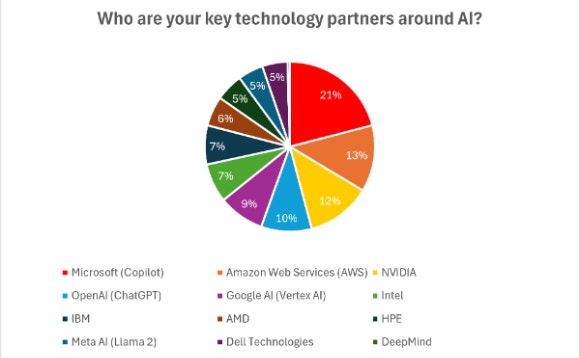
OpenAI secured ten per cent of mentions, reflecting ChatGPT's influence on the broader AI market, while Google AI attracted nine per cent of responses.
Other frequently cited partners included Intel and IBM (seven per cent each), AMD (six per cent), HPE (five per cent), Meta AI (five per cent) and Dell Technologies (five per cent).
The breadth of responses illustrates how AI is becoming embedded across the technology stack, spanning infrastructure, cloud, security and end-user productivity.
Skills remain the biggest obstacle
Despite growing momentum, the survey found that partner skills are the industry's most significant challenge.
Nearly a third of respondents (32 per cent) identified a lack of skills among the partner base as the biggest barrier to making generative AI offerings available through the channel.
Security concerns ranked second, receiving 15 per cent of responses, while an equal number said they either do not have or do not plan to have generative AI offerings available through the channel.
Only a small number pointed to a lack of in-house knowledge or insufficient funding for enablement programmes.
The qualitative feedback painted a more nuanced picture. Several respondents highlighted partner enablement as a priority, while others pointed to uncertainty around proving tangible return on investment for customers.
One respondent noted they had "not seen a deal won or lost because of AI offerings" but expected that to change as education improves. Another highlighted customer concerns around ensuring the right data is being fed into AI systems.
Cutting through the noise
Beyond skills, respondents repeatedly referenced market saturation and customer confusion.
With AI now a feature of almost every vendor marketing message, standing out from the crowd has become increasingly difficult.
One respondent described the challenge as operating in a market where "almost every vendor claims to do AI", making differentiated messaging critical for partners trying to articulate value to customers.
Others pointed to the rapid pace of technological change, the need to identify meaningful use cases and concerns that buyers themselves may not yet be ready to invest.
Several security-focused vendors also highlighted the challenge of preparing partners to design, deploy and support increasingly autonomous AI-driven platforms and workflows.
Opportunity remains enormous
Taken together, the findings paint a picture of a channel that recognises AI's transformative potential but is still navigating the path to widespread adoption.
The good news for vendors is that most have already moved beyond the planning stage and are equipping partners with solutions they can monetise today. The less encouraging reality is that skills development, enablement and customer education remain significant hurdles.
As AI continues to evolve from emerging technology to mainstream business tool, success may depend less on who has the most sophisticated technology and more on who can best help partners understand, position and deliver real-world outcomes.
For now, the channel's verdict appears clear: AI opportunity is abundant, but readiness still has a lot of headroom to grow.