The EMEA Channel: growth is back, but so are the constraints
CRN research highlighted the six key trends shaping the EMEA channel at XChange EMEA 2026
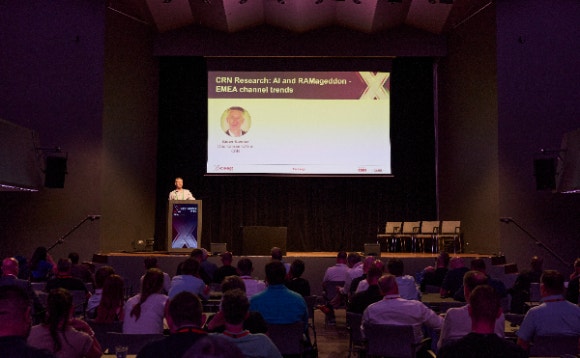
The EMEA IT channel has rarely looked as confident, or as complex, as it does in 2026. Demand is strong, pipelines are building, and artificial intelligence is driving a new wave of investment. And yet, beneath that optimism sits an awkward reality: executing in this market has become more difficult.
Margins are under pressure, delivery timelines are less predictable, and partners are navigating a fresh bout of component and memory constraints driven not by collapse in supply, but by explosive demand, particularly from AI infrastructure. Growth has returned to the channel, but so has friction.
Across the UK, Germany, the Netherlands, France and Poland, six structural trends are reshaping how partners compete, and how they must operate to win.
AI is no longer a trend: it’s an operating model shift
The most important shift is that AI is becoming structural. CRN research shows AI is already impacting core partner functions: marketing, sales, customer support and service delivery, before it is fully monetised externally.
In Germany in particular research points to a very deliberate pattern: AI adoption is accelerating, but with a strong emphasis on compliance, data protection and provable return on investment before scaling. AI is inevitable, but execution must be secure and compliant.
Crucially, this internal-first adoption is becoming a credibility differentiator. Partners that fail to embed AI into their own operations increasingly struggle to position themselves as trusted advisers to customers trying to do the same.
The services model has won: now it has to scale
If AI is the catalyst, services remain the engine.
CRN research data consistently shows partners prioritising growth in recurring and managed service revenues, while expecting vendor programmes to evolve to support this shift. In the UK especially, services-led growth is now dominant in partner strategy.
The implication is clear: competitive advantage is no longer defined by product access or portfolio breadth. It is defined by operating model: how consistently a partner can deliver, retain and expand customer relationships over time.
This transition is no longer optional. It is structural.
Security and governance are now part of enablement
AI’s rise has brought an unavoidable side effect: risk.
CRN Germany reporting highlights a widening gap between rapid AI usage and lagging security controls, with employees often using private AI tools and exposing sensitive data in the process. This is pushing security and governance into the foreground, particularly in compliance-driven markets.
The result is a shift in positioning. Security is no longer a parallel conversation. It is becoming a prerequisite for innovation. Partners that can package AI enablement with governance, control and transparency are increasingly the ones winning complex deals.
Cloud is no longer about migration, it’s about AI readiness
The traditional cloud conversation: migration, cost, flexibility, is evolving.
CRN research highlights what many partners are now calling the ‘AI halo effect’: interest in AI is pulling through broader investment in data platforms, infrastructure, networking and endpoint management.
Customers are no longer asking whether to adopt AI. They are asking whether their environments are ready for it.
For partners, this creates a powerful opportunity. AI itself may still be early-stage and unevenly monetised, but the foundational work required to support it is immediate, essential, and highly monetisable when packaged as part of a managed services strategy.
AI Is Also reshaping how partners go to market
While much of the AI conversation focuses on customer solutions, another transformation is happening quietly: partner marketing.
Research from CRN’s sister consultancy brand IPED shows solution providers increasingly using AI for segmentation, customer insight, and campaign execution. But it also reveals a widening capability gap. Larger partners are more likely to build and deploy custom AI tools to protect proprietary data and enhance targeting, while smaller partners remain reliant on off-the-shelf platforms.
The net effect is clear. Execution quality, not marketing volume, is becoming the differentiator. Partners that can target, personalise and convert more effectively are pulling ahead.
Resilience and sovereignty are back on the board agenda
If AI is future-facing, resilience is immediate.
The UK channel has been particularly shaped by recent outages, regulatory change and growing data sovereignty concerns. CRN’s analysis shows a clear shift from theoretical discussions about control and localisation to practical investment in hybrid models, regional infrastructure and sovereign data strategies.
This reframes infrastructure conversations entirely. Hybrid cloud, continuity planning and localised control are no longer technical discussions, they are board-level priorities tied directly to risk, compliance and trust.
The Hidden Force: component and memory constraints
Underlying all six of these trends is a quieter but increasingly important factor: the return of supply-side tension.
There is significant pressure in memory, storage and selected CPU segments, driven primarily by demand from AI data centre buildouts. Distributors warn of supply tightening and price volatility, while vendors have acknowledged that constrained supply is affecting partners across the board.
But this is not a repeat of the pandemic-era crisis. Demand has not collapsed. Instead, it has shifted.
The impact is therefore more nuanced and arguably more strategic:
Margins are under pressure, particularly in hardware-heavy, fixed-price deals
Lead times are less predictable, affecting project delivery and customer expectations
Product allocation favours higher-end, higher-margin workloads, especially AI-related infrastructure
Constraint as a catalyst
Importantly, these supply constraints are not redefining the market in isolation. They are reinforcing the broader structural trends.
As hardware becomes less predictable and less profitable, partners are pushed further toward:
Services-led models, where revenue is less tied to component availability
Cloud consumption, reducing dependency on physical infrastructure constraints
Architecture flexibility, including alternative sourcing and design approaches
Outcome-led delivery, where value is defined by results, not components
In this sense, the component squeeze is not a standalone trend. It is a forcing function accelerating the evolution of the channel itself.
One region, five markets, different emphases
While these trends play out across EMEA, their weighting varies by market.
UK: Strong emphasis on resilience, sovereignty and services-led delivery
Germany: Cautious, compliance-led adoption of AI, with a premium on proof and ROI
Netherlands: Pragmatic execution, with recurring revenue maturity and AI-led infrastructure demand
Poland: Acceleration mode, with strong focus on cybersecurity, cloud and AI competitiveness
France: Broad alignment with core EMEA trends, with similar pressures around security, AI and services evolution
The strategy remains consistent, but localisation matters.
The Bottom Line
The EMEA IT channel in 2026 is defined by a paradox. It is a growth market but a constrained one.
AI is now structural. Services models are dominant. Security and resilience are non-negotiable. And beneath it all, supply chain volatility is quietly reshaping how partners deliver, price and position their offerings.
The winners will not simply be the partners who chase growth. They will be the ones who build for it, combining flexibility, operational discipline and outcome-led thinking in a market that increasingly rewards execution over ambition.