‘The biggest opportunity the channel has seen in a generation’: MSPs urged to move beyond AI experimentation
Research unveiled at CRN’s XChange MSP showed how investment and customer demand are reshaping managed services
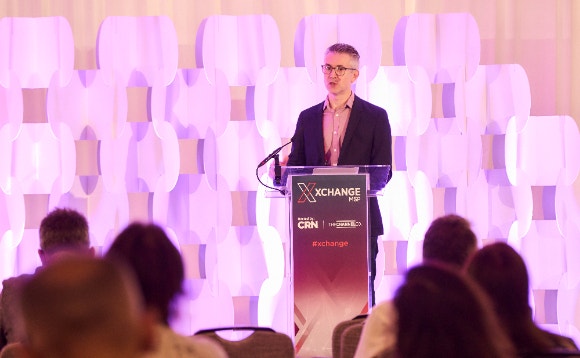
A few hundred metres from the bustle of Oxford Street, MSP leaders gathered in London’s Grosvenor Square to hear a rather different kind of sales pitch: stop experimenting with AI and start making money from it.
AI could represent the biggest opportunity the channel has seen in at least a generation, but MSPs will need to move beyond experimentation to capitalise on it, according to new The Channel Company research presented at CRN UK**’s XChange MSP**.
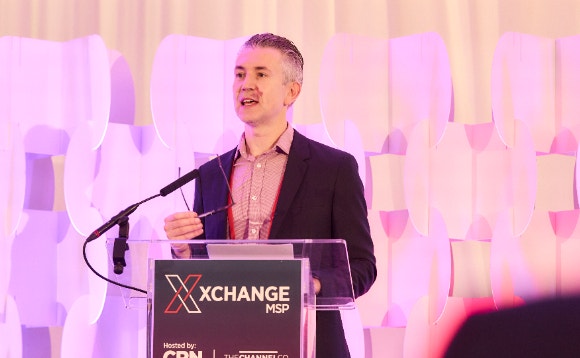
Presenting the findings at the London Marriott Hotel Grosvenor Square during the Growth and Gamble: The MSP Balancing Act session, The Channel Company’s chief content officer Stuart Sumner said the managed services market is undergoing “structural change” as AI, cybersecurity, cloud complexity, consolidation, regulation and changing customer expectations reshape the sector.
The UK-focused research, conducted by The Channel Company’s IPED consulting arm, found the MSP model continues to grow faster than other partner business models, while customers are increasingly outsourcing responsibility for complex technology environments.
Sumner said the next stage will be defined by MSPs’ ability to turn emerging technologies into scalable services rather than simply experimenting with them.
“AI may represent the biggest opportunity the channel’s seen in at least a generation,” he told attendees.
“It’s going to reward execution, not just experimentation alone.
“AI has been around for a few years. We should be moving past that experimentation phase.
“The MSPs that win will be those that combine trust, repeatability, automation and innovation.”
MSP market enters ‘structural change’
Sumner argued that describing the current upheaval in the channel as a “transition” understates the scale of what MSPs are facing.
“What we’re experiencing right now is very much structural change,” he said.
“The managed services market is being reshaped around us simultaneously by AI, cybersecurity, cloud complexity, consolidation, changing customer expectations and increasing regulation.”
Those shifts are forcing providers to simultaneously balance operational efficiency, customer protection and future innovation.
But the underlying market remains attractive.
Technology is becoming harder for customers to manage, while AI is opening conversations around a much wider range of services.
Sumner described this as an “AI halo effect”, where a customer might initially approach a partner to discuss AI before the conversation expands into data governance, databases, security or cloud services.
“The market is restructuring in favour of MSPs that can deliver repeatable, scalable and increasingly AI-enabled services,” he said.
“The question isn’t whether change is coming. The question is where you choose to invest to remain valuable to your customers and strategic to your vendor ecosystem.”
Skills gap drives customers towards MSPs
The research also points to a shift in why customers are turning to managed services.
Cost reduction, historically one of the main drivers for outsourcing IT, has fallen down the list.
Technology complexity emerged as the biggest demand driver, cited by more than 60 per cent of partners surveyed.
More than half pointed to cybersecurity risk, while AI adoption is rapidly emerging as another factor.
Almost 90 per cent of partners said their customers’ biggest challenge is securing enough skills and expertise to manage technology effectively.
“Customers aren’t buying services simply because the tech exists,” Sumner said.
“They’re buying services because they increasingly can’t manage that technology by themselves.”
The proliferation of AI, security requirements and hybrid infrastructure is consequently increasing the importance of outside expertise.
“The more AI expands, the more security requirements increase and the more hybrid infrastructure grows, the more valuable expert partners become,” Sumner added.
“That’s the strongest argument for your relevance we’ve seen in a very long time.”
77 per cent of partner revenue comes from existing customers
The findings also suggest that MSP expansion is increasingly about deepening existing customer relationships rather than relying predominantly on new logos.
Research from The Channel Company’s EMEA cohort found 77 per cent of partner revenue comes from existing customers, leaving 23 per cent from net-new business.
While that particular figure comes from its EMEA-based research rather than the UK sample, Sumner said similar themes are emerging across the markets studied by IPED.
“Growth is less about finding entirely new opportunities and it’s more about expanding your relevance inside existing accounts,” he said.
When asked about their expansion strategies, 86 per cent of partners identified organic development, while 71 per cent are launching new services and 75 per cent are adding technologies and supplier relationships.
M&A is also becoming more prevalent.
Sumner said acquisition activity is no longer concentrated among the channel’s largest players, with regional and specialist MSPs increasingly turning to buyouts to expand their capabilities.
MSPs still searching for AI service model
Despite the pace of change, many MSPs remain midway through transforming their business models.
Investment is being directed towards recurring revenue, managed services expansion and professional services as providers seek greater predictability.
AI is becoming an increasingly important part of that shift, but Sumner said the market has yet to establish what an AI-enabled managed service ultimately looks like.
Some providers are building consulting practices, while others are developing analytics propositions or exploring AI infrastructure and digital services.
Sumner expects that model could take another one to two years to settle.
“One thing is pretty obvious: the winners won’t just use AI internally. They’ll package that AI into repeatable customer outcomes,” he said.
“But the partners that are really getting the most revenue from AI today are the ones that experiment on themselves first and then take that credibility, those learnings into market.”
Scalability overtakes headcount as investment priority
The research also found that MSPs are prioritising technology over headcount as they look to increase sales output.
Systems and tools ranked as the top sales investment priority, cited by 75 per cent of partners, ahead of processes and people.
The shift reflects an increasing focus on automation, analytics, service delivery platforms and operational efficiency.
MSPs are increasingly applying better data and automation across the customer lifecycle, spanning prospecting, onboarding, service management, renewals and account expansion.
The objective is to generate more customer insight, become more proactive, increase margins and build longer relationships.
“In many ways, the future of the MSP isn’t just a service provider,” Sumner said.
“It’s a software-enabled operating platform for customer technology.”
Security investment jumps fourfold
AI topped MSPs’ tech investment priorities, with cybersecurity close behind.
Strategic AI investment has more than doubled over the past five years, according to the research, while security investment has increased more than fourfold.
But Sumner argued the larger opportunity extends beyond spending directly on AI.
Cloud platforms, networking, data architecture, security and governance are all becoming prerequisites for customers looking to successfully adopt the technology.
That creates an opportunity for MSPs to benefit from the infrastructure investments being made by hyperscalers, provided they have the capabilities to support customers as they adopt and manage those workloads.
“The real story isn’t AI alone. It’s the infrastructure surrounding AI,” Sumner said.
“These are all huge opportunities in the world of AI and all these capabilities are becoming prerequisites for successful AI adoption.”
For MSPs, Sumner said the opportunity is significant, but not automatic.
“It’s a huge opportunity for everyone in this room, but only for MSPs with the skills, processes and service models to truly capture it.”