TD SYNNEX, Dell and Nvidia launch AI Lab programme for the channel to turn AI into profit, not pilots
As part of AI Week, CRN is shining a spotlight on a UK initiative to help partners build, test and take monetisable AI solutions to market
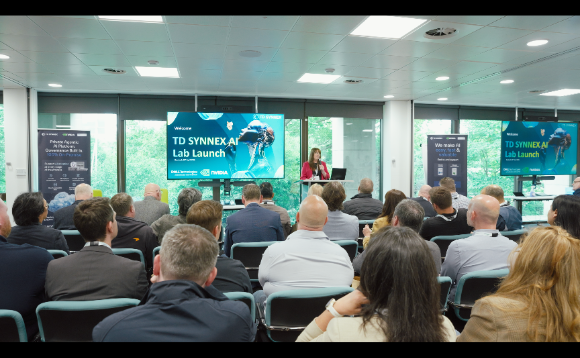
TD SYNNEX, Nvidia and Dell are urging partners to move past internal AI pilots and start creating monetisable use cases using customer data.
The clarion call comes with the opening of a new UK AI lab designed to help the channel build and test these use cases before scaling them in market.
The facility forms part of TD SYNNEX’s wider Destination AI programme and follows earlier launches in Germany and France. For the distributor, it marks a shift away from awareness building towards something more commercial, and more urgent.
“It’s not a paid for model. It’s a free service that we’re offering,” Simon Bennett, MD Advanced Solutions at TD SYNNEX told CRN at the Lab’s opening in Bracknell.
“We expect and hope this will be an active partnership with our alliance partners and the channel. This is important for our industry and we don’t believe anyone else has this to offer today.”
The initiative is backed by Dell and Nvidia, with both vendors providing key infrastructure for the state-of-the-art facilities.
MSPs and ISVs were present to tour the site. This is a weighty investment for the trio of tech giants. And there is a clear sense that leaders form each company are aware of the zeitgeist regarding generative AI right now.
While the technology is maturing, many organizations are facing challenges in scaling their investments, proving ROI, and managing risks like hallucinations.
A year ago, many conversations were still exploratory. Now, that is simply not enough. As CRN is reporting, the expectation is that partners need to move faster to monetise this technology.
That is reflected in what Dell sees as a successful outcome.
“A validated demo, a proof of concept, a repeatable offer or a first customer deployment: that would be a utopia outcome!” Said Steve Young, SVP and MD, Dell UK, during an exclusive roundtable with CRN.
The next step, he added, is doing that consistently, not just once.
AI use cases: pressure building from customer boards
Much of the urgency is coming from customers rather than the supply side. According to TD SYNNEX, organisations are no longer asking how much time AI can save, but what business outcomes the technology can solve for.
“What is driving the urgency is that buyers now have AI initiatives coming from the board, but they’re stuck in proof of concept,” Bennett said. “They are asking where to start and where the return is.”
That pressure is filtering directly into the channel, where partners are being asked to provide clearer answers.
Nvidia’s regional director of UK and Ireland Enterprise and Public Sector, Anthony Hills, added that the gap between interest and execution remains significant.
“It’s easy now to talk about AI. Everyone can demonstrate a chatbot or an assistant,” he said. “What’s much harder is to show business AI. To show something that is real, that works and that drives an outcome.”
The aim of the lab is to close that gap. Partners can bring in their own use cases, test them with real customer data and build something they are confident taking back to customers.
“The power of using customer data in those demos is huge,” Hills added. “It shortens the sales cycle and changes the quality of the conversation.”
AI in the IT channel needs to be about profitability, not just innovation
For TD SYNNEX, the lab is also a direct response to ongoing concerns about profitability in the channel.
The distributor has been increasingly vocal about the need for partners to monetise AI rather than simply enable it, and to build services and repeatable offers instead of relying on product margins alone.
“That partner becomes stickier. They become more profitable. They attach their own services,” Bennett said. “We have built this to help partners be more profitable and to still be around in the next few years.”
That message lands at a time when many partners are facing margin pressure alongside rising customer expectations. In parallel, constraints around GPU availability continue to shape how quickly projects can move forward.
Against that backdrop, the lab is being positioned less as a showcase and more as an enablement platform.
Changing how partners engage customers
For Dell, the shift is as much about behaviour as it is about technology.
“Infrastructure is a small part of delivering an AI outcome,” Young said. “We know what we’re good at, but we need partners who can turn a use case into an outcome for the customer.”
That means working more closely across the ecosystem, pulling in ISVs and applying industry expertise to real scenarios rather than generic AI use cases.
Some partners are already making that move, he said, but others will need to adapt.
“We want partners moving faster from pilot to production,” Young added. “That’s where the value is.”
Nvidia’s Anthony Hill pointed to the broader opportunity across the AI stack, from infrastructure through to applications, as partners expand their role.
“It gives partners the chance to build new relationships and move into areas they didn’t play in before,” he said. “And to serve their customers faster.”
Mindset still the biggest barrier
While the technology itself is becoming easier to access, all three companies pointed to internal challenges within partner organisations.
“The barrier to entry is lower than it has ever been,” Hills said, referencing the shift towards more accessible AI tools and agent driven models.
But, according to Bennett, many businesses have yet to organise themselves around that opportunity.
“Do you have someone responsible for digital transformation? Quite often the answer is ‘no’,” he said.
He argued that the channel’s issue is not a shortage of skills, but how those skills are currently used.
“I don’t think we have a skills shortage. I think we have an untapped potential problem,” Bennett said. “There is a lot of talent already there, but people are still tied up in the way they’ve always worked.”
Part of the answer, he added, is for partners to start with themselves, applying AI internally before taking it to customers.
From early use cases to repeatable offers
The longer-term aim is to move beyond isolated projects into something that can scale.
TD SYNNEX expects the next phase of its AI strategy to focus more heavily on vertical use cases, building on the work already underway in its European labs.
“The awareness phase was about 12 months ago. Now it is about building use cases in the right vertical segments,” Bennett said.
Early success stories will be important in driving wider adoption.
“If someone can see another partner doing this successfully, that creates belief,” he added.
For Nvidia, that creates what Hills described as a “lighthouse effect”, where visible wins encourage others to follow.
The UK AI Lab: ‘Come and use it’
The message from all three companies to partners who have not yet engaged is straightforward.
“Bring your customers in and show them what AI can do,” Hills said.
Bennett framed it more directly as a call to action.
“Use Destination AI to support your own transformation. Re engineer your business model, your value proposition and how you go to market,” he said.
And for Dell, the opportunity is more fundamental than just a new revenue stream.
“It’s not about what can I sell,” Young said.
“It’s about how I can make my customers successful. If you lead with that, you can have a very different conversation in the boardroom.”