What are UK SMBs actually buying in 2027?
At XChange MSP, partners and end users revealed where SMBs are spending today and how budgets could shift in the run-up to 2027
For many UK SMBs, the technology spending conversation has shifted.
Core investments such as licensing, managed services, cybersecurity and IT support continue to dominate budgets, but organisations are becoming more focused on governance, risk management and extracting measurable business value from new technology purchases.
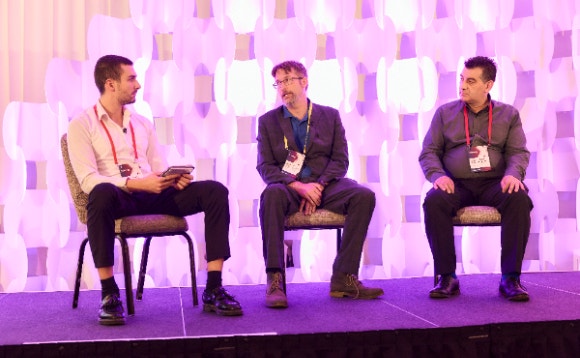
At XChange MSP 2026, CRN senior reporter Paul Ferretti chaired a panel of channel and end-user leaders to find out where SMBs are spending today, how tangible value is becoming more important against a backdrop of price increases across the board and how technology priorities are likely to evolve over the coming year.
Which technologies are UK SMBs spending today?
SMBs are still buying IT support as a service, but it is increasingly navigating away from reactive to proactive, and with the rise of AI adoption, governance is also becoming more important to SMB customers.
Marcus Evans, MD of Nutbourne Ltd, explained, “I'm seeing a lot more governance being bought at a higher level.
“Just conceptually, I think there's probably more available risk to an organisation in general, and also we can add a lot more value and stay a lot more relevant if we're selling the VCIO package at a high level.”
Licensing remains a top technology for SMBs, with Evans explaining that he has clients licensing both Google and Microsoft products.
From a user perspective, Nick Ioannou, information security manager at EDMISTON, described that he has spent his career purchasing solutions that extend beyond working hours, ensuring the business is always covered.
“We're only working eight hours a day, but the business is 24 hours a day.
“So [the purchases] extend our own teams work, whether that’s email monitoring, XDR, UDR, half web monitoring, anything like that.”
How much customer demand is out there for AI, and what are customers already paying for?
No two companies are alike, and the appetite for AI technologies differs across the board due to differing priorities and concerns.
“You're seeing some two to three person companies who have gone absolutely gangbusters on trying to develop their own agents and building everything internally with no concept of what that means from a risk perspective. And then you're looking at charities who are really concerned about what it means for their people, so they're stalling on the AI investment,” explained Evans.
While at completely different ends of the spectrum, Evans explained that all of these businesses need an education into what AI is, what the associated risks are and the return that they can get.
The channel has moved beyond SMBs wanting to implement AI because they know they should implement it, which was the case a couple of years ago, to the desire to want to successfully implement it at a larger scale, largely driven through education initiatives that partners are offering.
Although, when discussing agentic AI, the conversation shifts.
“I think agentic is a little bit more challenging in terms of what you deliver, but there is a desire for it.
“Currently, it’s more about meeting customers where they are, working out what they want and looking at the business outcomes,” Evans explained.
Then there is also a disconnect between vendors and end users, with Evans explaining:
“A lot of the time we try and sell what the vendors tell us we should be selling, and actually, there's a disconnect there between what the clients actually want and what we should be trying to do for an outcome.”
Echoing this sentiment, Ioannou explained, “A good MSP understands your business, or more importantly, they'll help you to ask the right questions so you actually understand your own business.”
He explained that his organisation is currently undergoing a data governance project, which he referred to as “the dull bit”.
Although, this “dull bit” is what will build the foundation that new technologies will be attached to, and the advice from an MSP is exactly why the boring stuff should come before ushering in new technologies, in order for them to work as intended without causing harm to the business.
Which technologies have attracted a lot of attention but haven’t translated into meaningful customer spend?
“I think Copilot clearly isn't selling as much as Microsoft would have liked, otherwise they wouldn't have changed the incentives to sell it quite so hard,” Evans said. “AI is developing beyond the demand.”
As MSPs, the job is to educate clients and tell them what they need, rather than sell what the vendors want them to, a point Evans made earlier.
“It’s not sexy, it’s governance, it’s cybersecurity and making sure they don't get a breach, or at least reducing the risk of getting a breach by 10% which is quite a difficult sell.”
“On the one hand, we're trying to educate them.
“We're trying to say, ‘you need to buy this because it's good for you, and this is what you need.’
“Then on the other hand, [customers are] saying, ‘oh yeah, but what about this? I want to buy this’, and it might not be the right thing for them, but it's what they want to buy.”
Is customer demand becoming more price sensitive?
Pricing is becoming one of the most important factors for customers, with Evans explaining that most recently, customers are being driven by up-front cost, rather than the value an MSP can provide.
In the initial bartering stage, “you don't get to demonstrate value, you don't get the opportunity to open the door.”
So, from this, he is entering conversations offering a stripped-back service, and once in the door, is able to show customers the roadmap, and the various services they provide, and explaining why the services come with a certain price to hit certain objectives.
In terms of pricing, on the customer side, hardware prices have been a big conversation.
Ioannou explained that he had bought someone in his team a low-level laptop for less than £2000, the same now costs around £4000, “we're getting hit left, right, and centre with additional costs.
“With an IT budget, we have a certain amount of slack, but we just can't keep absorbing endless uplifts.”
These price increases, for the same products, are continuously eating way at SMB budgets, leaving less budget for services.
Where will SMB technology budgets be spent in 2027?
The industry is intrigued to know where budgets will be spent in the next year, and the panellists have some ideas.
AI has caused a lot of worry on workforces, and this will continue, as Evans predicts SMBs will begin to cut their workforce.
“SMBs will start to make people redundant, but they're replaced with agentic AI, then a lot more of a budget is opened up because they're not paying expensive salaries and minimum wages.
“Although, you can see other SMBs going the other way.”
For Ioannou, he echoes a similar sentiment, “wage use is one of the biggest constraints.
“With technology, you don’t need to replace people that leave, and there’s just going to be more of it.”
Although the panellists agreed that these operations will have huge implications for the economy of people.
While the big focus is AI, the core of that interest is technology that will give time back to employees, which, for Ioannou, has also come in the form of updated hardware.
“It’s not just AI, it’s having better laptops and better software.
“You can buy time not just with AI; you can buy time just through newer tech.”
Ioannou reflected on a purchase made a year ago for someone in the finance team.
Every month he would complete a task which took four hours.
A new laptop was purchased, and the task was able to be completed in 20 minutes.
“It costs the same [as his old laptop], it just needed a refresh.
He adds: “So, just by some clever technology purchases, you can make life a lot easier for people because the tech has improved so much.”